Him, not hem
And when they had crossed over, they came to land at Gennesaret. And when the men of that place recognized him, they sent around to all that region and brought to him all who were sick and implored him that they might only touch the fringe of his garment. And as many as touched it were made well. Matthew 14:34-36 (ESV)
This is one of those sections of the Bible which I've read dozens of times but it never appeared particularly notable. It certainly says something to how much drama is in Matthew's account of the life of Jesus that this was a non-event by being a relatively routine occurrence.
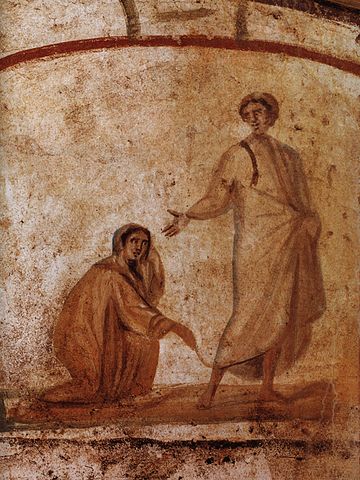
What struck me recently was how this must have been a response to the events of Matthew 9 where a woman lunges for the edge of Jesus' robe out of pure necessity, and is immediately healed after twelve years of bleeding. It's not long after when these men try to follow her example.
What the woman did out of necessity[1], the men in this subsequent town repeated as a method. Who would blame them? Touch the hem, get healed. A relatively painless formula in the grand scheme of things.
But the formula didn't last very long. Jesus would only be walking the earth for a little while longer and his robe would be torn apart and gambled away. I wouldn't be surprised if one of the Roman soldiers let people touch his section of the robe for a few denarii, a sort of prototype for the future relic trade. After all, there were still many contemporaries who had success stories from the "hem equals healed" formula, and practical advice often outlives the circumstances that made those the advice practical and useful in the first place. Methods are passed down almost without fail, but motives are ignored almost without exception.
The reason the woman grasped for the hem of Jesus' robe was because Christ held healing power in himself, while the townsmen asked to touch it because they saw a pattern that worked in the past. Frankly, most teaching on healing hasn't evolved much since then. It's usually new rituals for the same cargo cult. Sometimes they work, just like slamming electronics on the ground sometimes fixes them[2]. But in both cases, the real issue turns out to be connection. If you can become connected with Christ, then you can find healing in some form on some timescale. That way doesn't have the guaranteed promise of an instant miracle, but truthfully, neither do any of those methods, new or old.
After ruminating on this for years, I can't help but think we'd be better by emphasizing loftier relational aims even if it means living on the fringe, rather than chasing after the latest faithy fashion.
[1] It would've been inappropriate if not punishable to touch Jesus given her health situation, never mind any cultural mores about touching a man.
[2] Perhaps all methods are wrong, but some are useful.
Originally published in March 2013 and last updated in August 2021.